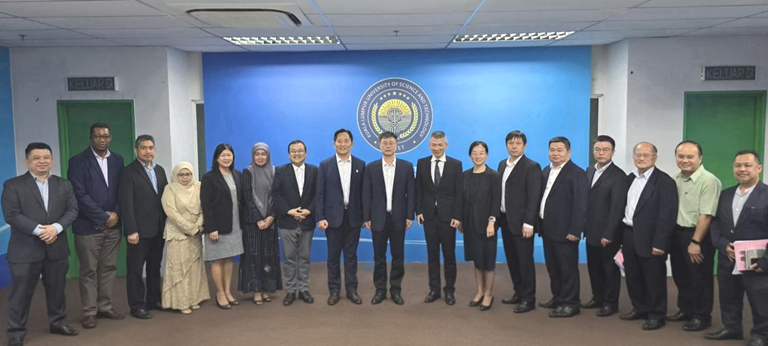
On December 17, a delegation led by Professor Wang Fazhou, Deputy Secretary of the Party Committee and President of Wuhan University of Technology (WUT), paid a friendly visit to Kuala Lumpur University of Science and Technology (KLUST). The delegation included Xiang Fan, Director of the International Office; Mr. Fan Tao, Director of the Office of Planning and Discipline Development; Professor Zhou Bin, Deputy Dean of the Undergraduate School; and Professor Wu Chaoqun, Dean of the School of Mechanical and Electrical Engineering.
The KLUST delegation was led by Prof. Chen Xiaoyun, Chairman of the Board; Prof. Ts. Dr. David Ngo Chek Ling, President and Vice-Chancellor; Tan Sri Dr. Ghauth Jasmon, Chairman of Academic Expert Board; Prof. Dr. Huam Hon Tat, Deputy Vice Chancellor (Academic), and Prof. Dr. Suraya Amirrudin, Deputy Vice Chancellor (Student Affairs, Culture & International Relation), among others. The visit aimed to further strengthen bilateral cooperation, explore new pathways for the internationalisation of education, and inject fresh momentum into China–Malaysia education collaboration.
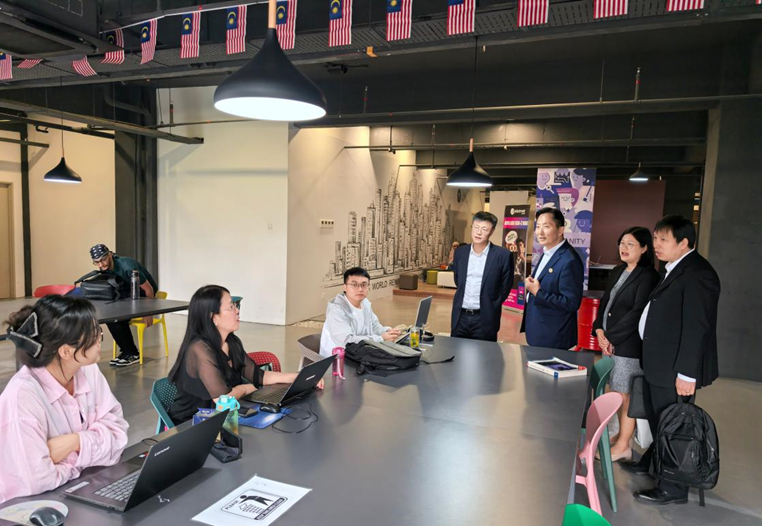
Prior to the meeting, the WUT delegation toured KLUST’s University Hub located at the Block 11 ground floor, the Student Hub at level 5, classrooms and other teaching facilities.
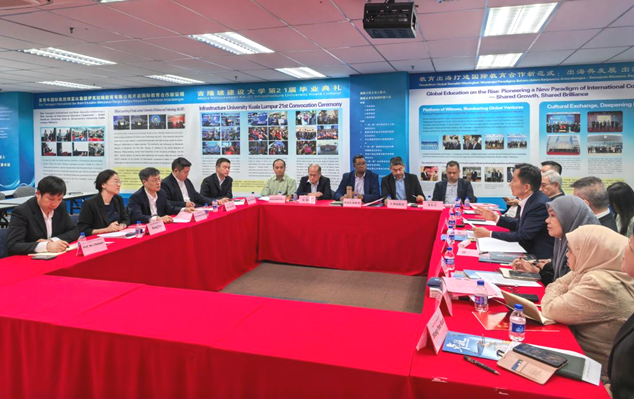
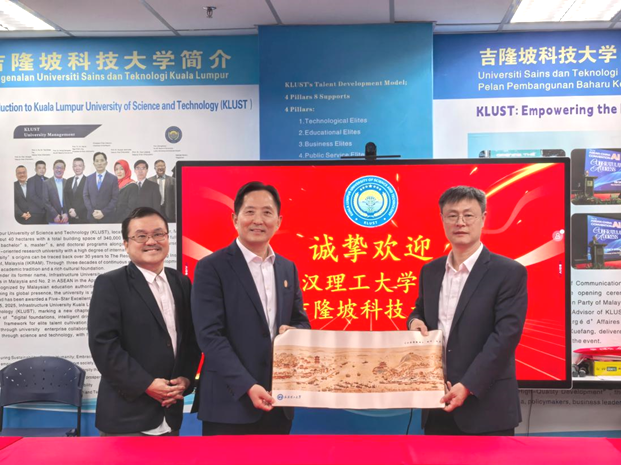
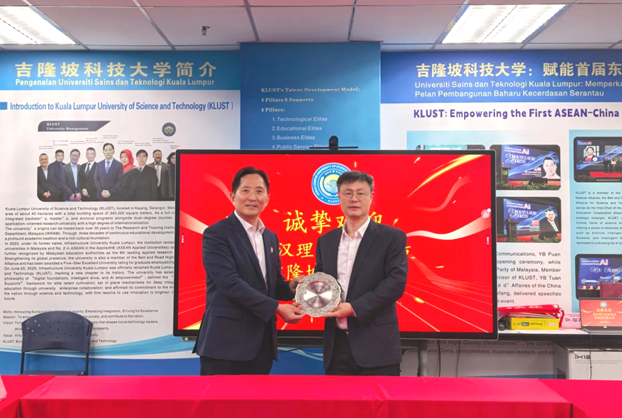
Representing KLUST, Prof. Ts. Dr. David Ngo Chek Ling warmly welcomed Prof. Wang Fazhou and his delegation. He noted that since its rebranding as Kuala Lumpur University of Science and Technology, the University has upheld the educational philosophy of “Built on Digital Technology, Lifted by Intelligence, Empowered by AI”, continuously deepened industry–academia integration, and expanded collaboration with industry leaders, with the goal of building a high-quality, leading technology university in ASEAN. At present, KLUST has established a comprehensive academic structure comprising 28 undergraduate programmes, 16 master’s programmes, and 10 doctoral programmes. Prof. David Ngo emphasised that the two universities share many commonalities in their educational directions and enjoy broad prospects for cooperation. He expressed KLUST’s eagerness to work closely with Wuhan University of Technology to jointly explore new pathways for educational development.
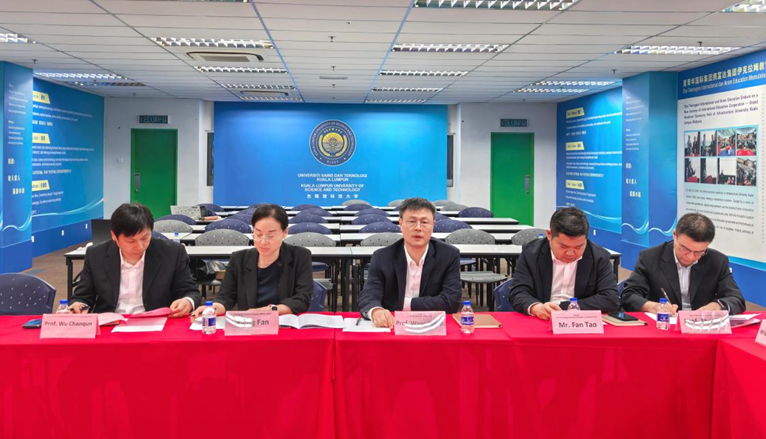
Prof. Wang Fazhou provided an overview of Wuhan University of Technology. He noted that as a key national university directly under China’s Ministry of Education, and among the first institutions included in the national “Project 211” and “Double First-Class” initiatives, WUT has consistently focused on cultivating high-quality talents who lead technological frontiers, industry innovation, and regional development. He emphasised that this visit represents a concrete step in advancing the University’s opening-up in education and supporting the high-quality development of the Belt and Road Initiative, as well as a pragmatic effort to strengthen China–Malaysia friendship and achieve mutually beneficial cooperation. Against the backdrop of deepening China–Malaysia exchanges and the accelerating new wave of technological and industrial transformation in areas such as artificial intelligence and new energy vehicles, Professor Wang highlighted the growing demand for high-tech innovation and high-level talent cultivation. In this context, WUT hopes to deepen international cooperation with KLUST in talent development, faculty and student exchanges, and collaborative research, better serving national strategies and regional socio-economic development.
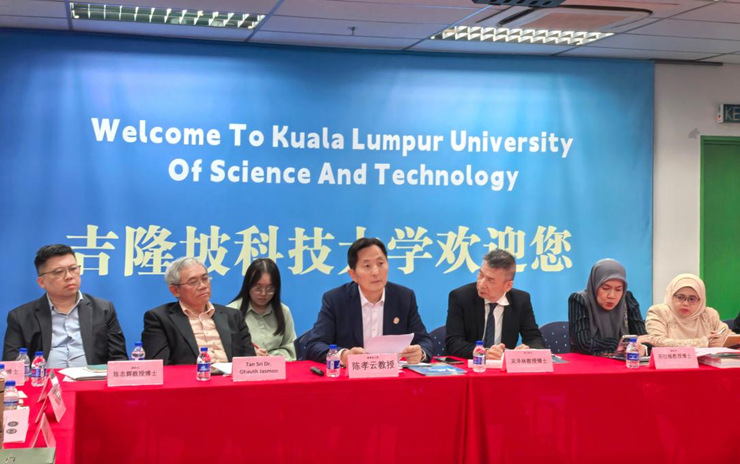
In a keynote presentation titled “Focusing on ASEAN, Advancing KLUST: Building a Community for International Education Cooperation under the ‘Education Going Global’ Initiative”, Professor Chen Xiaoyun provided a comprehensive overview of KLUST’s development. Guided by the Belt and Road education initiative, KLUST adheres to a development approach centred on “win-win cooperation, service to local development, industry–academia integration, and ASEAN leadership”. The University follows the principle of aligning education with industry and advancing in parallel with enterprises, creating a new paradigm for “education going global”. By building a holistic talent development framework, KLUST strives to become both a cradle for high-quality talent and an important bridge for China–Malaysia friendship. Professor Chen emphasised that deepening industry–academia integration is central to the University’s development strategy. KLUST closely aligns with industry needs, focuses on technological innovation and experimental training, strengthens platform development, and attracts high-quality technological resources from China and ASEAN to Malaysia, fostering a dynamic innovation and industrial ecosystem. He expressed the hope that both institutions would explore in-depth cooperation models in joint education programmes, talent cultivation, and collaborative research, achieving resource sharing and complementary strengths to nurture elite talents with global competitiveness.
Both sides engaged in in-depth discussions on key areas including joint education programmes, faculty and student exchanges, and scientific research innovation, and reached multiple cooperation intentions. In terms of educational collaboration, the two universities plan to jointly establish high-level joint institutes focusing on frontier fields such as artificial intelligence and big data, adopting a “2+2” dual-campus training model that integrates high-quality educational resources from China and Malaysia. In addition, they aim to establish a multi-tiered talent exchange system, including regular exchange programmes, distinctive dual-degree courses, and Belt and Road-themed practical projects, to enhance mutual understanding and friendship between Chinese and Malaysian students while promoting cultural exchange and heritage.
In the field of research, both parties plan to jointly build international research platforms with a focus on new energy materials, marine engineering, and AI applications. Through the establishment of academic exchange mechanisms, the two universities seek to cultivate a vibrant academic community. With joint efforts from both sides, cooperation between Wuhan University of Technology and Kuala Lumpur University of Science and Technology is expected to yield fruitful outcomes—bringing new opportunities for the development of both institutions while contributing to the high-quality advancement of the Belt and Road Initiative and the building of a China–Malaysia community with a shared future.
In recent days, Kuala Lumpur University of Science and Technology (KLUST) has successively welcomed several groups of distinguished guests. These included Professor Shi Qian, Secretary of the Party Committee of the School of Economics and Management at Tongji University; Professor Li Shuangshou, Director of the Teaching Committee of the Basic Industrial Training Center at Tsinghua University, and his delegation; Professor Li Shunxing, Secretary of the Party Committee of Minnan Normal University, and his delegation; as well as delegations led by Mr. Chen Siguang, Honorary Chairman of the Beijing Intangible Cultural Heritage Development Foundation, and Ms. Han Shuxian, Executive Dean of the Beijing Hengshan Academy.
During the discussion sessions, the delegations engaged in in-depth exchanges on key topics including joint education programmes, faculty and student exchanges, scientific research and innovation, and industry–academia integration, reaching multiple cooperation agreements.